


2026 Report on the State of Data Protection
SealPath has conducted a study on the security and control of confidential data in organizations to understand the current measures and concerns of security managers throughout the data lifecycle.
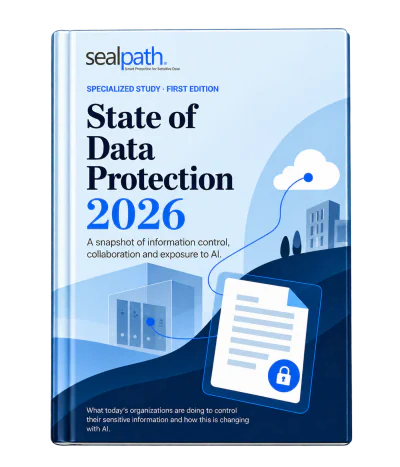
Read the full 2026 State of Data Protection Report
Protecting data requires more than just controlling access
The 2026 State of Data Protection report reveals a gap between the security measures in place and the ability to maintain control over sensitive information when it is shared with third parties or used in AI tools.
%
Of security professionals can change permissions after sending a file.
%
Confirm that sensitive information has been entered into AI tools.
%
Rate the overall effectiveness of their protection technologies as high in keeping their data safe.
Key findings
Organizations control access, but not so much the document itself
85% of participants report applying the principle of least privilege, and 69% say they can revoke access. However, only 36% can modify a document’s permissions after sending it, and just 21% report having persistent protection in place. Furthermore, only 14% say they know where copies of the information are located. These results show that managing access does not always guarantee continued visibility and control over information once it has been shared.

Organizations control access, but not so much the document itself
85% of participants report applying the principle of least privilege, and 69% say they can revoke access. However, only 36% can modify a document’s permissions after sending it, and just 21% report having persistent protection in place. Furthermore, only 14% say they know where copies of the information are located. These results show that managing access does not always guarantee continued visibility and control over information once it has been shared.

AI policies do not always translate into technical controls
48% of participants confirm that sensitive information has been entered into AI tools, and another 20% suspect this has happened. Although 78% report having an AI usage policy in place, only 26% implement technical measures to block the upload of information to these tools. The results highlight the challenge of complementing policies and training with technical controls that help prevent the exposure of sensitive information.
Sharing information with third parties does not always mean maintaining control
72% of participants share sensitive information with third parties at least occasionally. However, only 46% say they can revoke access to shared information, and 32% can audit third-party access. These results highlight the challenge of maintaining control and visibility over information beyond the organization itself.

Sharing information with third parties does not always mean maintaining control
72% of participants share sensitive information with third parties at least occasionally. However, only 46% say they can revoke access to shared information, and 32% can audit third-party access. These results highlight the challenge of maintaining control and visibility over information beyond the organization itself.

Having technology does not always translate into high perceived effectiveness
Although 91% of participants report having at least one protection technology, only 42% rate its overall effectiveness as fairly high or very high. Furthermore, 59% state that their controls do not prevent the exposure of sensitive information to AI, or only do so partially. The results suggest evaluating not only which tools are deployed, but also the level of protection they provide in real-world scenarios.

Data sovereignty is gaining importance in security decisions
83% of participants consider data sovereignty to be important or mandatory. In addition, 72% apply this criterion to AI tools that process sensitive information as well. Data location and processing are thus established as key factors when evaluating services, providers, and tools involved in the information lifecycle.
Having technology does not always translate into high perceived effectiveness
Although 91% of participants report having at least one protection technology, only 42% rate its overall effectiveness as fairly high or very high. Furthermore, 59% state that their controls do not prevent the exposure of sensitive information to AI, or only do so partially. The results suggest evaluating not only which tools are deployed, but also the level of protection they provide in real-world scenarios.
Data sovereignty is gaining importance in security decisions
83% of participants consider data sovereignty to be important or mandatory. In addition, 72% apply this criterion to AI tools that process sensitive information as well. Data location and processing are thus established as key factors when evaluating services, providers, and tools involved in the information lifecycle.

Frequently Asked Questions About the Report
What is the 2026 State of Data Protection Report?
It is a study by SealPath that analyzes how organizations protect and control their sensitive information. It examines document protection capabilities, collaboration with third parties, exposure associated with the use of artificial intelligence, and the main challenges faced by security teams.
What information and conclusions will I find in the report?
The report compiles statistics on data protection practices and the control capabilities that organizations report having. It includes findings on permissions management, the protection of shared documents, the exposure of sensitive information to AI tools, collaboration with third parties, and data sovereignty.
Who is this report intended for?
It is primarily intended for CISOs, information security managers, IT managers, and other technology professionals interested in evaluating data protection practices and identifying potential areas for improvement within their organizations.
How was the report prepared?
The SealPath study was conducted in July and August 2026 through a survey of 1,052 CISOs and security and technology professionals. The results are based on the responses received to each question and reflect the practices and perceptions reported by the participants. This is an exploratory study, not a statistically representative sample of the entire market.
Additional Resources
Data Governance Guide
A guide with all the information you need to know about governance and how to implement it.
Tools Against Shadow AI
Learn more about how to protect sensitive company data that is shared with AI systems.
About SealPath
SealPath is a European company specializing in data-centric security, with more than a decade of experience helping organizations protect their sensitive information. It operates in more than 30 countries and serves leading companies across various industries, including Euro Stoxx 50 and Fortune 500 organizations. Millions of documents are protected every day using its technology. Its solution combines encryption, permissions, and traceability for protected documents to help maintain control over information when it is shared within or outside the organization.